How to Choose the Right School Uniform Manufacturer in India: Complete Guide
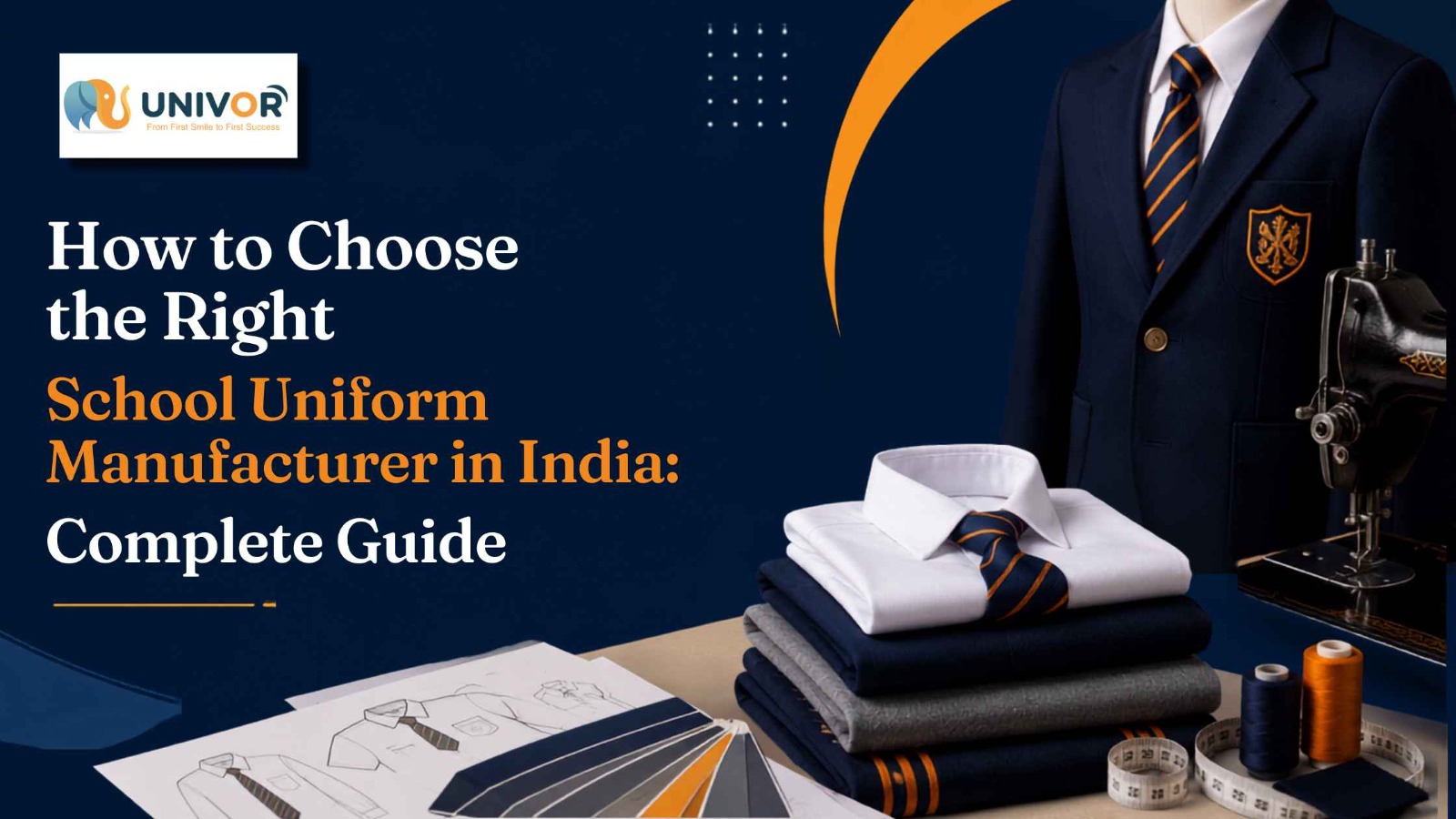
Choosing a school uniform manufacturer is not simply about finding someone who can stitch shirts, trousers or dresses in bulk. For schools, preschools and education groups, the right uniform partner needs to deliver consistent quality, comfortable fabrics, accurate sizing, strong branding, reliable timelines and dependable bulk supply—year after year.
A school uniform is also part of the institution’s identity. The colours, fit, fabric, logo and overall appearance contribute to how students represent their school every day.
With so many uniform suppliers, local tailors and manufacturers available in India, how do schools choose the right school uniform manufacturer?
This guide explains the most important factors to evaluate before placing a bulk school uniform order.
Why Choosing the Right School Uniform Manufacturer Matters
A school may order hundreds or even thousands of uniforms at a time. A small problem in fabric quality, sizing or stitching can therefore become a major operational issue.
For example, if uniforms fade after repeated washing, students may need replacements sooner than expected. If sizing is inconsistent, parents may struggle to find the right fit. And if different branches receive slightly different colours or designs, the school’s visual identity can become inconsistent.
A professional school uniform manufacturer in India should therefore provide more than manufacturing capacity. Schools need a partner that understands their requirements, academic calendar and brand identity.
At UNIVOR Global, school uniform solutions are designed around customized uniforms, school kits, branding and bulk supply for educational institutions across India. The company states that it has 21+ years of industry experience and has served 1,000+ schools. (univorglobal.com)
1. Check the Quality of the Fabric
Fabric should be one of the first things a school evaluates when selecting a school uniform supplier.
Students wear uniforms for several hours every day, often throughout the week. The fabric therefore needs to balance:
- Comfort
- Breathability
- Durability
- Colour retention
- Easy maintenance
- Suitability for India’s climate
A fabric that looks attractive in a sample may not necessarily perform well after repeated washing.
Schools should ask potential manufacturers about the fabric composition, weight, finishing and expected durability before approving an order.
For a deeper understanding, schools can also refer to UNIVOR’s guide on how to choose the right school uniform fabric.
Pro tip: Don’t judge fabric only by touching a sample. Ask how it is expected to perform after regular school use and washing.
2. Prioritize Comfort and Child-Friendly Fabrics
School uniforms should be designed around the students who will actually wear them.
Children move constantly—walking between classrooms, playing outdoors, participating in sports and sitting through lessons. A uniform that looks premium but restricts movement or feels uncomfortable can quickly become unpopular.
Look for a school uniform manufacturer that understands:
- Breathable materials
- Comfortable fits
- Appropriate fabric weight
- Flexible construction
- Age-appropriate designs
- Easy movement
UNIVOR specifically highlights child-friendly fabrics that are soft and breathable for all-day school wear. (univorglobal.com)
The goal should be simple:
The uniform should support the student—not distract them.
3. Examine Stitching and Finishing Quality
Fabric is only one part of a quality uniform.
Before selecting a custom school uniform manufacturer, examine the sample carefully.
Check:
- Stitch density
- Seam finishing
- Button attachment
- Zippers
- Pockets
- Collar construction
- Cuffs
- Waistbands
- Embroidery
- Thread quality
- Overall finishing
Small details become important when uniforms are produced in large quantities.
A manufacturer that provides a sample approval process gives schools an opportunity to identify these issues before bulk production begins.
UNIVOR’s stated process includes consultation, customized sampling, approval through a sample kit and then bulk delivery. (univorglobal.com)
4. Check Whether They Can Maintain Consistent Sizing
Sizing is one of the most overlooked parts of school uniform procurement.
A manufacturer may produce a good sample, but the real test is whether the same specifications are maintained across hundreds or thousands of pieces.
Schools should ask:
Are the measurements standardized across every production batch?
A professional manufacturer should have clear size specifications for different age groups and garment types.
This becomes particularly important for:
- Preschool uniforms
- Primary school uniforms
- Secondary school uniforms
- Sports uniforms
- Winter uniforms
- Staff uniforms
Consistent sizing can reduce unnecessary exchanges and make the ordering experience easier for parents.
5. Look for Custom School Branding Capabilities
A school uniform isn’t just clothing. It is a visible representation of the institution.
A strong custom school uniform manufacturer should be able to incorporate the school’s:
- Logo
- Colours
- Typography
- Design elements
- Embroidery
- Badges
- House colours
- Custom patterns
The branding should remain consistent across the uniform and, where required, other school essentials.
UNIVOR offers customized school branding and positions its offering around uniforms, bags, books, stationery and other educational essentials customized to the institution. (univorglobal.com)
This can be especially valuable for schools that want a consistent identity across multiple locations.
6. Ask About Bulk Manufacturing Capacity
A manufacturer may be excellent at producing small quantities but struggle when a school places a large institutional order.
Before finalizing a supplier, ask about:
- Production capacity
- Minimum order quantities
- Lead times
- Seasonal demand
- Quality control
- Packaging
- Dispatch process
- Replacement orders
This is particularly important before the new academic session.
Schools should avoid discovering production limitations only after admissions have started.
A reliable bulk school uniform manufacturer should be able to plan production around the school’s requirements and delivery schedule.
7. Delivery Reliability Matters More Than You Think
A high-quality uniform delivered late can still create a major problem.
School uniform procurement is closely connected to the academic calendar. Uniforms may be required before:
- New admissions
- The beginning of the academic year
- Orientation
- School reopening
- Sports events
- Annual functions
Therefore, schools should ask potential suppliers:
What is your expected production and delivery timeline?
Also clarify how the manufacturer handles urgent replacements or additional quantities after the primary order.
UNIVOR states that it provides bulk manufacturing and pan-India supply, with its process designed around delivery of customized school kits. (univorglobal.com)
8. Consider a One-Partner School Supply Model
Many schools manage different vendors for uniforms, bags, books and stationery.
That can create unnecessary coordination.
One supplier handles uniforms.
Another handles bags.
Another handles books.
Another handles stationery.
A complete school kit supplier can simplify this process by bringing multiple requirements under one partnership.
UNIVOR positions itself as a one-stop solution for uniforms, bags, books, stationery and school branding, helping institutions reduce the need to coordinate multiple vendors. (univorglobal.com)
For school groups and preschool franchises, this can be particularly useful because maintaining consistent products across locations becomes easier.
9. Check Experience With Schools and Educational Institutions
Manufacturing uniforms for schools is different from ordinary garment production.
The manufacturer needs to understand:
- Institutional requirements
- Large size ranges
- Repeat orders
- School branding
- Academic calendars
- Bulk production
- Parent-facing requirements
- Branch-level consistency
Before choosing a supplier, look at their experience with schools, preschools and education groups.
Ask for relevant samples and, where available, case studies or references.
This helps you evaluate whether the manufacturer understands the education ecosystem rather than simply manufacturing garments.
10. Always Approve a Sample Before Bulk Production
This is perhaps the most important practical step.
Never approve a large uniform order based only on photographs or verbal promises.
Request a physical sample or sample kit and evaluate:
Fabric → Fit → Stitching → Colour → Branding → Comfort → Finishing
Then provide written approval before bulk production begins.
UNIVOR’s stated process follows a similar sequence: understand requirements, customize samples, allow approval and then proceed to bulk manufacturing and delivery. (univorglobal.com)
School Uniform Manufacturer vs Local Tailor: What Should Schools Choose?
Local tailors can be useful for very small or highly specific requirements. However, schools managing larger quantities often need greater consistency and production capacity.
Factor |
Local Tailor |
Professional Uniform Manufacturer |
| Bulk production | Limited | Stronger capacity |
| Standardized sizing | May vary | Structured |
| School branding | Usually possible | Specialized |
| Repeat orders | Can vary | Easier to standardize |
| Multi-branch supply | Difficult | More suitable |
| School kits | Usually limited | Can be integrated |
| Quality consistency | Depends on individual | Structured processes |
The right choice ultimately depends on the school’s scale and requirements.
For a growing school or multi-branch education group, a specialized manufacturer can offer a more structured procurement solution.
What Should You Ask a School Uniform Manufacturer Before Ordering?
Before signing off on your supplier, ask these questions:
- What fabric will be used?
- Is the fabric suitable for daily school wear?
- Can you provide physical samples?
- How do you maintain sizing consistency?
- Can you customize the school’s logo and colours?
- What is your minimum order quantity?
- What is the expected production timeline?
- How do you manage quality control?
- Can you handle repeat and replacement orders?
- Can you supply bags, books, stationery and other school essentials?
- Do you supply across multiple cities or branches?
- What happens if there is a quality or sizing issue?
A manufacturer that can answer these questions clearly is much easier to evaluate.
Final Checklist: Choosing the Right School Uniform Manufacturer
Before making your final decision, look for these 7 essentials:
✓ Quality fabric
✓ Comfortable, practical designs
✓ Consistent sizing
✓ Strong stitching and finishing
✓ Accurate school branding
✓ Reliable bulk production and delivery
✓ Responsive support for repeat and replacement orders
The cheapest supplier is not necessarily the most cost-effective option. A uniform that lasts longer, fits better and maintains its appearance can provide better value over the entire academic year.
Why Schools Choose UNIVOR
UNIVOR Global combines school uniform manufacturing, customized branding and complete school-kit solutions for educational institutions. Its offering includes student uniforms, sportswear, staff uniforms and other school essentials, with a stated focus on preschool franchises and standalone institutions. (univorglobal.com)