Custom School Uniforms in India: A Complete Guide for Schools & Institutions
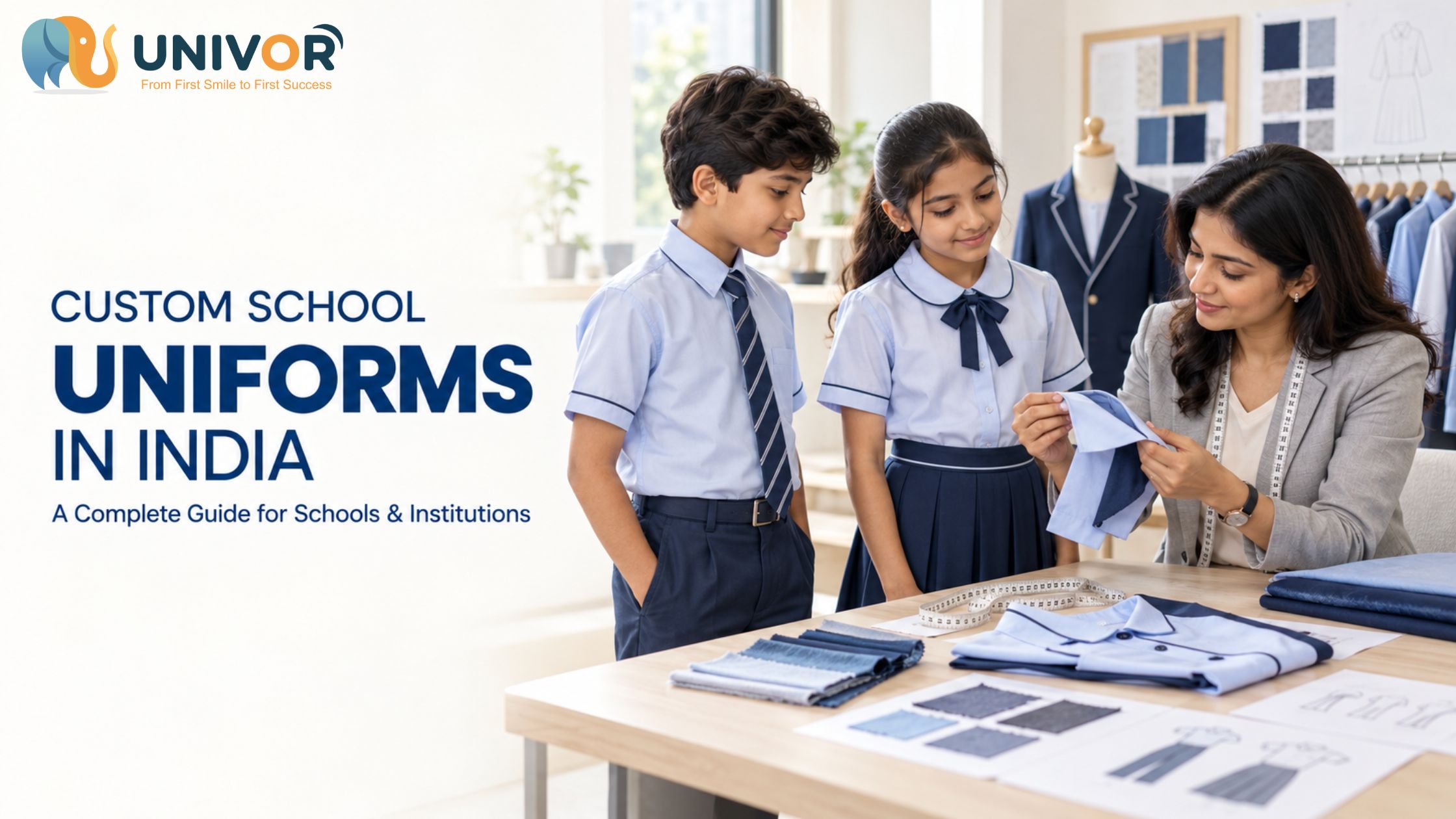
Custom school uniforms in India do more than make students look coordinated. A well-designed uniform system helps a school communicate its identity while supporting comfort, practical movement, straightforward maintenance and consistent purchasing across academic years. The challenge is not simply choosing a shirt colour or placing a logo. It is turning a school’s requirements into repeatable garments that children can wear comfortably and administrators can reorder reliably.
Whether you manage a preschool, an independent school, a group of campuses or an expanding franchise, this guide explains how to plan custom school uniforms—from defining needs and approving designs to checking samples, managing sizes and preparing for bulk supply.
What Are Custom School Uniforms in India?
Custom school uniforms in India are garments developed or adapted to an institution’s agreed requirements. Customisation may involve colours, fits, fabric blends, collars, piping, embroidery or printing, house colours, garment labels and coordinated accessories. It may also involve a documented size range and specification sheet so later batches match the original order.
A “custom” uniform does not necessarily mean that every seam must be new. Schools often get better consistency by choosing a proven base garment and modifying only the elements that matter: school colours, branding and appropriate fit. The right approach depends on age group, budget and expected use.
1. Start With the School’s Real Requirements
Before looking at swatches, define who will wear each garment and when. Preschool uniforms, daily formalwear, sportswear and winterwear often need different designs. A single uniform style may not serve every age and activity equally well.
- Map garments by stage: preschool, primary, middle and senior school.
- Separate daily, sports/house, winter and staff requirements.
- List applicable climate, campus activities, care expectations and budget constraints.
- Confirm who approves designs and how branches will request replenishment.
India’s National Curriculum Framework for School Education notes that uniforms communicate school identity and that decisions should consider local climate, safety, availability and cost-effectiveness. This offers a sound starting point for institutional decisions.
Read the Ministry of Education’s National Curriculum Framework (2023).
2. Choose Fabrics for Comfort, Climate and Use
Fabric selection should go beyond a hand-feel test. Ask for the fibre composition, fabric weight, finish, expected care method and documented performance information where available. The most suitable fabric is not always the thickest one; comfort depends on construction, breathability, movement, local weather and how the garment is worn.
- For everyday shirts and polos, evaluate softness, airflow and repeated-wash appearance.
- For trousers, skirts and joggers, assess stretch or ease, opacity, abrasion areas and seam strength.
- For sportswear, evaluate movement, moisture management claims only when supported, and comfort during activity.
- For winter layers, check layering space, closures and suitable warmth for the region.
Request test information for colourfastness, shrinkage and seam quality where appropriate, and agree what happens if supplied goods differ from an approved sample. Avoid accepting unverified “premium” or “100% durable” claims as substitutes for specifications.
3. Create a Clear School Uniform Design Brief
A written brief keeps decisions consistent between school management, designers and manufacturing teams. It should be simple enough to use for approvals and detailed enough to prevent interpretation errors.
| Specify | What to document |
| Garments | Shirt/polo, trousers, skirt, tracksuit, hoodie, blazer and other items |
| Colours | Physical colour swatch or approved reference; where each colour appears |
| Construction | Collar, sleeve, pockets, buttons, piping, waistband and fit |
| Branding | Approved logo artwork, exact size, position and method |
| Sizes | Measurement chart, tolerances and size distribution |
| Packing | Individual labels, grade/size assortment, branch-wise cartons |
For schools planning complete outfit systems, UNIVOR School Wing lists uniforms, sportswear, staff apparel, bags and student kits as part of its institutional offering.
Explore UNIVOR School Wing and available categories.
4. Decide How School Branding Should Appear
School logos need to remain recognisable across different garments and sizes. An embroidery design that looks crisp on a blazer may be unsuitable for a lightweight sports T-shirt, while print choices should be evaluated against the actual fabric and care instructions.
- Use approved high-resolution/vector artwork and documented brand colours.
- Approve logo width, position and clearance on each garment type.
- Review a physical branded sample for readability and comfort.
- Document the agreed method for future repeat orders.
Do not assume one technique is best for every garment; ask the manufacturer to show samples and explain maintenance requirements.
5. Build a Practical, Inclusive Size Range
One of the most expensive uniform problems is a batch that looks correct but fits poorly. Schools should plan for growing children, different body proportions and movement during school hours. Where appropriate, consider accessible closure options and flexible uniform choices consistent with school policy.
Request actual garment measurements rather than relying only on age labels. Conduct a fit trial with an appropriately varied group and check sitting, reaching, bending and walking. Record adjustments before issuing a full-size chart.
6. Approve a Physical Sample Before Bulk Production
The sample approval is where a school verifies that the design brief matches the garment in hand. A photograph cannot fully show fabric behaviour, finishing or fit.
Custom school uniforms in India: sample approval checklist
- Fabric composition and texture match the specification.
- Colour, piping, buttons and trims match the approved references.
- Logos are correctly placed and remain legible.
- Seams, hems, collar, cuffs and closures are finished cleanly.
- Fit, garment dimensions and size labels match the approved chart.
- Washing/care instructions and packaging are clear.
Sign off a “golden sample” and keep a copy or securely documented reference for future deliveries. UNIVOR also discusses this approach in its guide to consistency across school branches.
See UNIVOR’s multi-branch uniform standardisation guide.
7. Plan the Bulk Order Around the Academic Calendar
A reliable bulk order needs more than a total quantity. Build an item-wise, size-wise and campus-wise order list, agree cut-off dates for approvals, and document milestones for materials, manufacturing, quality checks, dispatch and replacements.
For multi-campus groups, centralise the approved specification while allowing branch-specific quantity planning. Reserve time for sample revisions and account for the possibility of size exchanges or extra student admissions. Confirm minimum order quantities, timelines and change policies with the supplier in writing.
8. Compare Quotes on Total Value, Not Just Unit Price
A low unit cost can turn expensive if the product needs early replacement, if logos are inconsistent or if reordering is difficult. Ask for quotes that identify all included and excluded services.
| Cost question | Why it matters |
| Is sampling included? | Avoid approval-stage surprises. |
| Are branding and labels included? | Understand the true garment cost. |
| What are size/quantity minimums? | Plan economical reorders. |
| How are defects handled? | Clarify inspection, correction and replacement. |
| Are packing and freight included? | Compare delivered cost across suppliers. |
9. Check Product Care, Labelling and Reorder Consistency
Care instructions should reflect the actual textile and decoration. Washing, drying and ironing symbols must not be guessed. India’s Bureau of Indian Standards maintains textile-care labelling guidance; schools can ask manufacturers how they determine care instructions for the finished garment.
Check the BIS standards portal for current textile-care labelling standards.
For continuity, request product codes, an approved specification, records of shade and trim choices, and a process for repeat orders. Reorders should be checked against the approved sample rather than treated as unrelated purchases.
10. Ask the Right Questions Before Choosing a Manufacturing Partner
The most useful supplier conversation is evidence-led. Bring the design brief and request straightforward answers about sampling, production, quality and follow-up support.
- Can you produce and revise an actual sample before bulk approval?
- How will fabric, colour, dimensions and logo consistency be checked?
- Can you provide size-wise packing and branch-wise dispatch details?
- What is the process for size exchanges, defects and reorders?
- Which claims about fabric performance can be supported with documentation?
- Who is accountable for coordinating updates before dispatch?
How UNIVOR Can Support Custom School Uniform Requirements
UNIVOR Global’s School Wing describes institutional solutions that include school uniforms, sportswear, winterwear, teacher/staff apparel, bags, student kits, branding and custom packaging. Its manufacturing enquiry form lets schools share organisation details and product requirements, including garments, quantities, colours, sizes and customisation needs.
Schools can use that consultation process to discuss a custom brief and request details about sampling, feasibility, price and timelines. Specific features, performance levels and delivery terms should always be confirmed in the final written quotation and approved sample.
Submit a custom uniform manufacturing enquiry to UNIVOR.
Quick Custom Uniform Procurement Checklist
- ☐ Requirements mapped by garment and age group
- ☐ Fabric and colour references approved
- ☐ Artwork and logo placements documented
- ☐ Size chart checked through fit samples
- ☐ Golden sample signed off
- ☐ Quality criteria and defect process agreed
- ☐ Quote and milestones approved
- ☐ Branch-wise packing and reorder plan confirmed
Frequently Asked Questions
What are custom school uniforms in India?
They are school garments produced or adapted to agreed requirements such as colour, design, fit, school logo, labels and sizing. The extent of customisation depends on the school and supplier.
How early should schools order custom uniforms?
Begin planning well before the academic session, allowing time for design approvals, sampling, revisions, size collection and manufacturing. Ask each supplier for a written schedule rather than assuming a universal lead time.
Can schools customise polo shirts, sports uniforms and winterwear?
Yes, such categories can be customised in principle, but available options depend on the garment, fabric, production method and supplier capabilities. Confirm details through approved samples.
What should schools check in a uniform sample?
Check fabric, colour, measurements, movement, stitching, seams, trims, logo placement, care guidance and packaging against the written specification.
How can a school keep uniforms consistent across branches?
Use a master design brief, colour reference, size chart, approved golden sample, product codes and central quality checklist for all orders and reorders.
Is the cheapest school uniform quote always the best value?
Not necessarily. Compare the total landed cost, garment performance, included branding, sampling, packing, returns process and ability to supply consistent reorders.
Conclusion
Custom school uniforms in India work best when schools treat design and purchasing as one coordinated process. Start with students’ daily needs, define the fabric and garment specifications, make branding repeatable, approve fit and physical samples, and set clear quality and reorder procedures. That process creates a uniform system that is easier for schools to manage and more practical for students to wear.
For institutions developing or refreshing a uniform programme, the next step is a clear brief and a sample-led discussion with a capable manufacturing partner.